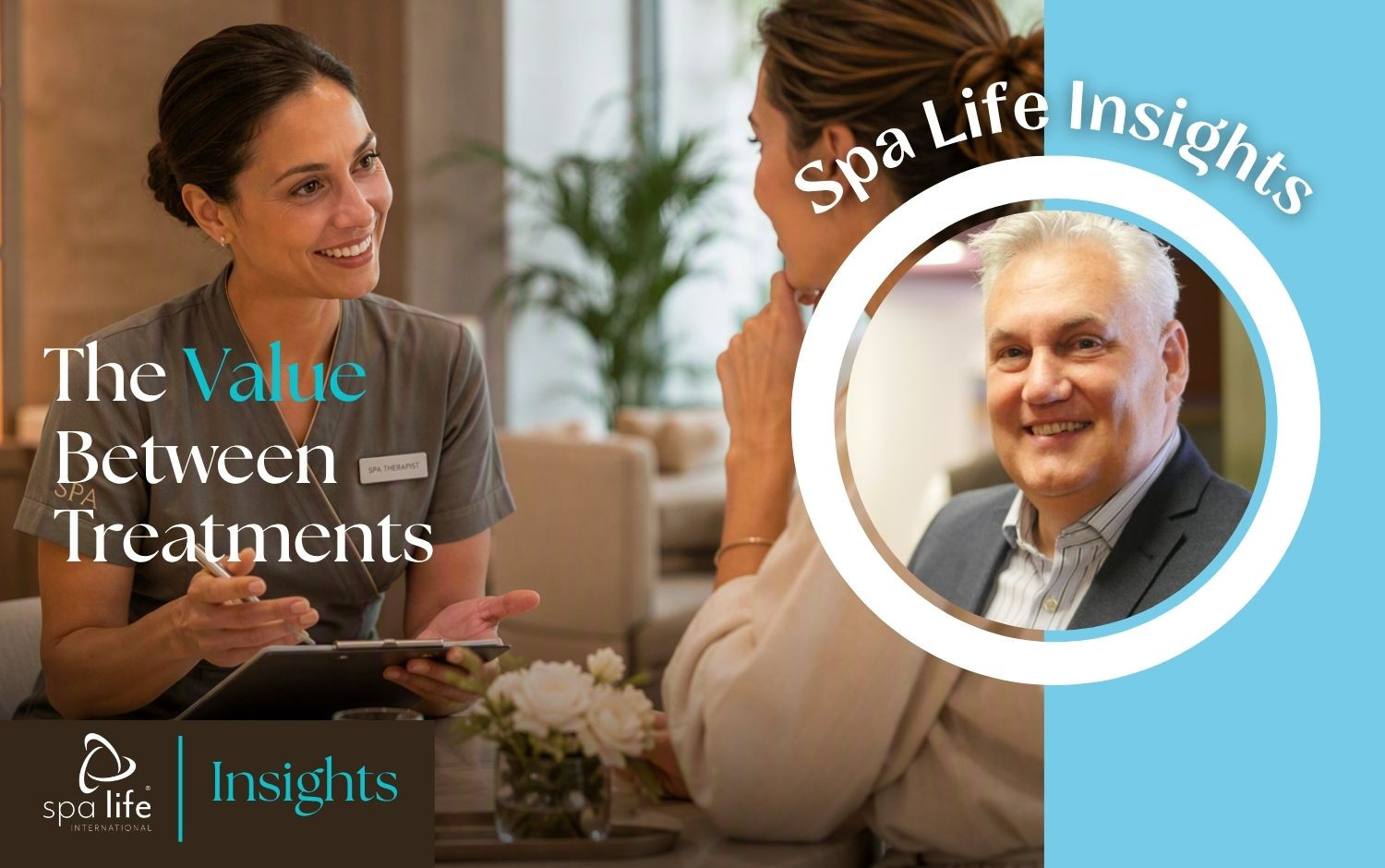
As recruitment continues to be one of the primary challenges facing the spa industry, spa managers are looking for ways to improve the productivity of their existing teams. In the latest Spa Life Insights newsletter, Andrew Hammond explores what productivity really means in a modern spa — and whether there are opportunities to create value beyond the treatment room.
If productivity has traditionally been measured by treatments, utilisation and revenue per hour, are we missing other ways in which a spa team can create value?
Ask a spa manager about productivity and the conversation will probably turn quite quickly to numbers.
Therapist utilisation. Treatments per day. Treatment room occupancy. Revenue per treatment hour.
These are important measures. In a treatment-led business, they have to be. But do they tell us everything we need to know about productivity?
And perhaps more importantly, does being more productive necessarily mean doing more?
Productivity or value?
This question has been coming up increasingly in conversations I’m having with spa leaders.
Massage remains one of the primary revenue drivers for many treatment-led spas, but it can also be physically demanding work. Therapists need recovery time, and changing attitudes towards work are creating new challenges for some employers.
Conversations with spa leaders highlight changing attitudes towards work, particularly among some younger therapists who may be less willing to deliver back-to-back massage treatments, placing greater emphasis on wellbeing, variety and work-life balance.
Whether this perception is entirely fair is beside the point. If it reflects a challenge that some spa leaders are encountering, then it raises a practical question: how can therapist time be used productively when they are not delivering treatments?
For managers, that creates a genuine commercial challenge.
If a therapist isn’t performing a treatment, their time still has a cost. So how can that time be used productively?
The obvious answer might be to find another treatment. But perhaps that’s where we need to challenge our traditional interpretation of productivity.
If productivity simply means maximising treatment hours, then the answer will always be more treatments.
If productivity means creating the greatest possible value from the people, time, skills and space available, the possibilities become rather more interesting.
Are we measuring the right things?
The traditional measures aren’t wrong.
Therapist utilisation matters. Treatment numbers matter. Room occupancy matters. Revenue per hour matters.
They help managers understand whether their operation is commercially efficient.
But there is a danger in allowing these measures to become the definition of productivity rather than indicators of it.
A therapist who spends an hour performing a treatment obviously generates revenue.
But what about the therapist who spends that hour conducting a consultation that leads to a treatment programme, recommending products that generate a retail sale, supporting a guest event, helping another therapist prepare for their next treatment or delivering a short wellness experience to a small group?
The financial value may not appear in the same line on the spreadsheet, but that doesn’t necessarily mean there isn’t value.
Perhaps the question should not simply be “What did they do?”
Perhaps it is “What value did they create?”
Are we using our people effectively?
The traditional spa model has been built around clearly defined roles.
Therapists deliver treatments. Receptionists manage bookings and guests. Spa assistants support the operation. Managers manage.
There is obvious value in specialisation, particularly where technical competence and guest safety are concerned. But there may also be value in becoming less rigid about where those skills can be used.
If a therapist has an hour between treatments, for example, could they become a spa ambassador, circulating through the wider hotel to raise awareness of the spa, engage with guests and perhaps generate a last-minute booking?
Rather than sitting in the staff room waiting for the next appointment, imagine a therapist in an elegant, tailored uniform moving through the property, visible and approachable, using their knowledge to have genuine conversations with guests about the spa and what it can offer.
Could therapists or spa attendants also support F&B within the spa, helping to increase food and beverage revenue? Could therapists gain experience supporting reception or booking systems, particularly where this could help develop their commercial and guest-service skills?
The possibilities will vary from one property to another, but the principle is the same: a therapist’s value doesn’t necessarily end when they leave the treatment room.
Perhaps the opportunity is to think less about filling every available hour of their time with treatments, and more about how the skills, knowledge and presence of the whole team can be deployed to create value wherever it is needed.
There is also an important qualification here.
If a therapist needs a recovery period after several physically demanding treatments, that shouldn’t automatically be regarded as wasted time. Nor should it necessarily become another opportunity to squeeze in a different treatment.
There may be other productive uses of that time — supporting a colleague, undertaking training, engaging with guests or developing new skills.
And sometimes, of course, the most productive thing a therapist can do is recover.
A fatigued therapist is unlikely to deliver their best work for very long. Perhaps sustainable productivity requires us to think about energy as well as time.
The future may be more multi-skilled
None of this suggests that there is a single model for the future, or that every therapist should suddenly become a generalist.
But there may be opportunities for more multi-skilled teams, where people retain their core professional expertise while developing complementary skills and contributing in different ways.
A therapist might also become a wellness host, product expert, educator or event contributor.
A spa assistant might develop stronger F&B, retail or guest-experience skills.
Reception teams might become more commercially involved, moving beyond bookings and administration into consultation, upselling and guest engagement.
These are possibilities rather than predictions. The right mix will depend on the property, the team, the guest and the commercial model.
The objective isn’t to dilute professional expertise or expect everyone to do everything. It is to build teams that can adapt to changing demand, provide greater opportunities for career development and make better use of the capabilities they already possess.
Perhaps the future of spa productivity isn’t about making existing roles work harder.
Maybe it is about designing better, more flexible roles in the first place.
Technology and space add another dimension
The same principle applies beyond people.
Technology can potentially create revenue or improve the guest experience without consuming another hour of therapist time. Touchless wellness experiences are one example.
AI and automation may reduce some of the administrative work currently carried out by managers and therapists.
And under-used rooms or facilities may provide opportunities for different experiences when traditional treatment demand is low.
The question becomes one of capacity.
How can we make better use of the resources we already have — human, physical and technological — rather than simply trying to increase output from the same model?
A different way of thinking about productivity
None of this means that the traditional measures should be abandoned.
A spa still needs to know how many treatments it is selling, how effectively its rooms are being used and how much revenue it generates per treatment hour.
But perhaps those numbers should sit within a bigger picture.
Because a productive spa isn’t necessarily one where every therapist is performing treatments every available minute.
It may be one where the right people are doing the right things at the right time — and where those activities create value for the guest and the business.
That could mean a treatment.
It could mean a retail sale.
It could mean a consultation, a wellness experience, staff development or simply creating the capacity to deliver better service later in the day.
Perhaps the real challenge is not to make every hour more productive, but to understand what makes an hour valuable.
That changes the question from:
“How many treatments can we fit into the day?”
to something potentially more useful:
“How can we create the greatest value from the time, people, skills and resources we already have?”
For some spas, the answer will still be another treatment. For others, it might be something entirely different.
And perhaps that is the opportunity: not simply to find more treatments, but to start finding more value between them.
As always, I would love your to get your thoughts.